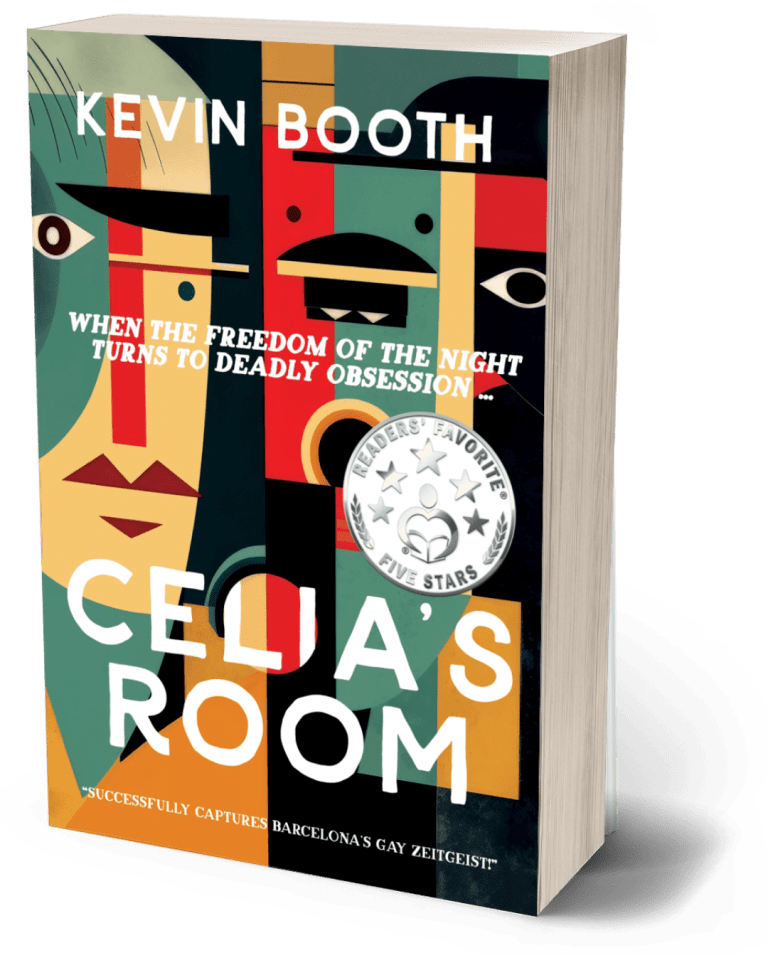
When the freedom of the night turns to deadly obsession …
A Five-Star Seal from Reader’s Favorite!
“Successfully captures Barcelona’s gay zeitgeist”
Reader’s Favorite is an industry-standard reviewing site that grades a book on its appearance, plot, development, formatting, marketability and overall opinion. In September 2025, Celia’s Room, my first novel, received a glowing five-star review from them, scoring the maximum five points in every category. This entitles me to use their silver seal in my book promotion. If you haven’t yet read
Celia’s Room, get it here.
“Stunning debut: If you like Kerouac or Isherwood, you will love Celia’s Room.”
Two budding artists, addicted to a nightlife as dangerous as it is dazzling, explore the dark underbelly of Barcelona’s nineties queer counterculture in this LGBT+ novel.
Joaquim, a sensitive painter, and Eduardo, a cynical writer, fall under the aura of Celia, an enigmatic creature of the night. The games they are learning to play, against the backdrop of a city that is also rehearsing a new identity, draw all three into conflict, leading them inexorably towards the truth of Celia’s Room.
With echoes of Jean Genet’s underworld and Pedro Almodóvar’s gender-fluid chaos, Celia’s Room explores the raw edges of art, desire and sexuality within the context of Spain’s blazing transition from dictatorship to democracy.
By purchasing direct from my website you help me earn a living as a writer.
Just ask your favourite bookshop to order this title in print by quoting its International Standard Book Number (ISBN): 9788461540976 (Ingram Spark) / 9780957655140 (epub) / 9780993229862 (KDP)
Or click a link to get it at the retailers below.
Click below to follow this author on BookBub.

Reviews
If you like Kerouac or Isherwood you will love Celia’s Room.
If you know Barcelona you will find the descriptions and characters completely authentic. I could almost smell the Gothic barrio.
I picked this novel up on a Sunday morning, intending only to read the opening salvo to decide whether I liked it enough to take with me on the train to work the next day. I didn’t put it down until I’d finished it five and a half hours later. It is gripping, intelligent and deeply sensual but also witty and fast-moving. I found it utterly compelling.
It is packed with shady eccentric characters and sharp poetic imagery. There are also passages of almost scholarly historic reference and beautiful expositions of particularly poignant works of art that give the plot a rich cultural context.
It’s also funny and very very entertaining… worth reading. And I hope this is an author worth watching out for.”
Nothing is quite as it seems. This book rejoices in ambiguity and ambivalence, successfully capturing the zeitgeist of Barcelona in the period when the optimism and openness precipitated by the restoration of democracy in Spain was fading as the ETA terrorist campaign continued to take lives, political corruption was exposed by the uncensored media, and the city began to undergo massive redevelopment for the Olympic Games of 1992.
Set mainly in the medieval Ciutat Vella (Old City), occasionally moving out to Camp Nou and the leafier uptown districts, the story unfolds through events narrated by two young men with very different backgrounds, perspectives and prospects. Both are engulfed by a nocturnal social milieu that will be immediately recognisable to anyone who experienced the last days of the notorious Barrio Chino before swathes of it were demolished to make way for the antiseptic Rambla del Raval.
Eduardo, a diplomat’s son used to a cosmopolitan life of privilege but traumatised by violent loss, is simultaneously dismissive of and drawn to tawdry “lowlife” decadence, distracting him from his career path. Joaquim, escaping a stultifying rural Catalan background and intent on becoming an artist, is easily entranced by flamboyance, and soon exploited to paint and decorate the interior of an aristocratic but dilapidated old mansion inhabited by a colourful cast of exotic characters with shady sources of income. Of these, the most enigmatic is Celia, a beautiful outsider who remains out of focus until the climax.
While most of the protagonists are recognisable Barcelona “types”, their personalities are not so much stereotypical as archetypal, rendered believable by ordinary human frailties. This is particularly true of Celia, whose mystique is heightened by infrequent but powerful utterances.
The narrators’ depictions of alcohol-driven, drug-fuelled bohemian nights of poetry and song, revolving between bars, after-hours dives and shared flats in the Gothic Quarter, contrast with their personal moments of unease and self-doubt. Misunderstandings amongst the revellers induce mistrust, jealousy, anger and shame. The inaugural house party held in the mansion to celebrate the pagan Vispera de Sant Joan (Midsummer’s Eve) brings these tensions to a sharp explosion of revelations and epiphanies.
The author’s knowledge and love of Barcelona are clear from his vivid descriptions of places, architecture and ambience. Another reviewer rightly admired the “passages of almost scholarly historic reference and beautiful expositions of particularly poignant works of art that give the plot a rich cultural context”.
There are some lovely turns of phrase, with flashes of poetic imagery, startling similes and curious metaphors. The tone ranges from lightly self-deprecating to deeply philosophical, with some parts written in an almost scientifically disinterested style and others using language so alluring and sensual as to qualify as genuinely erotic, without being pornographic.
As a meditation on sexuality, I found Celia’s Room insightful and thought provoking. Perhaps more importantly, I enjoyed the story a lot, and at times laughed out loud. This intelligent and entertaining book is fun, and definitely well worth reading!
 Poble Sec Books